Read · · 15 min read

Ten competitions are running at once in enterprise AI. Only one of them decides where the money settles.

Numbers at a glance
- 93% — Palantir Q2 2026 revenue growth, the fastest it has posted; revenue $1.94bn
- 149% — US commercial revenue growth, to $764m; +28% sequentially
- 155% — Rule of 40 score; adjusted operating margin 62%; adjusted free cash flow $1.22bn
- $8.15bn — raised FY2026 revenue guidance, roughly 82% growth
- −29.3% — Palantir's share price year to date going into the print; +12–15% after it
- −39.5% — the same close measured from the 207.52 high of 3 November 2025
- >50% — coding as a share of OpenRouter token traffic by mid-2026, up from ~11% in early 2025
- ~4× — growth in routed token volume over the same period (~5T to >20T tokens per week)
- 2.8tn — parameters in Moonshot's Kimi K3, released open-weight in late July 2026
- 18.7% — enterprises using outcome-based software pricing (Futurum, 1H 2026, n=830)
- 2 June 2026 — Microsoft IQ reaches general availability: Work IQ, Fabric IQ, Foundry IQ, Web IQ
- −11.9% / +89.2% — Rubin 100 build-out index, one month against year to date
1. The print and the polemic
On Monday evening Palantir reported the fastest-growing quarter in its history, and its chief executive used the occasion to attack the companies whose models his platform runs on.
The numbers first. Revenue of $1.94bn, up 93% year over year, at a scale where growth normally decays. US revenue rose 115% and now accounts for more than 81% of the total. US commercial revenue rose 149% to $764m, accelerating rather than fading. US government revenue rose 90% to $809m. Net income was $1.07bn. Adjusted operating margin reached 62%, giving a Rule of 40 score of 155%. The company closed 220 deals worth $1m or more, seventy of them above $10m. Full-year guidance moved up to roughly $8.15bn, implying about 82% growth, with US commercial guided above $3.42bn.
Alex Karp's framing of that quarter matters as much as the quarter. He told CNBC to forget consensus. In the shareholder letter and on the call he escalated a campaign he has run since the spring: that enterprises are engaged in what he calls tokenmaxxing — spending heavily on model consumption, receiving little measurable operational value, and surrendering their proprietary data and expertise to the model providers along the way. His characterisation of the frontier labs' posture was that they believe they “deserve to colonize your enterprise.” He has also positioned Palantir on the side of open weights, joining an industry letter urging Washington not to restrict them.
It would be easy to file this as a rivalry story: Palantir versus OpenAI and Anthropic, with a founder who is good at television. That reading is too small. What Karp is doing — loudly, and in his own commercial interest — is narrating a structural question the entire enterprise software market is now organised around:
When intelligence becomes abundant, where does the durable control point sit?
That question is not Palantir's alone, and it will not be settled by Palantir.
2. The mistake: reading this as one competition
The public conversation about AI competition is still conducted along a single axis — open models versus closed — with a second axis, local deployment versus API, occasionally acknowledged.
The enterprise market has already decomposed into at least ten overlapping competitions. Most serious companies sit on both sides of at least one of them.
| Competition | Side A | Side B | Principal players |
|---|---|---|---|
| Model ownership | Closed frontier models | Open-weight models | OpenAI, Anthropic, Google, xAI vs Meta, DeepSeek, Qwen, Kimi, GLM, Mistral |
| Deployment | Remote API / cloud inference | Self-hosted, local or sovereign | Frontier labs and hyperscalers vs Palantir, NVIDIA, Red Hat, IBM, Databricks |
| Architecture | Model-centric | Enterprise-context-centric | OpenAI, Anthropic vs Palantir, Salesforce, ServiceNow, SAP, Microsoft |
| Context | Documents and RAG | Semantic model / ontology | Frontier agent stacks vs Palantir Ontology, Microsoft Fabric IQ, Salesforce metadata, SAP Knowledge Graph |
| Integration | Open protocols | Proprietary workflow ecosystems | MCP and A2A ecosystems vs Microsoft Graph, MuleSoft, ServiceNow, SAP BTP |
| Agent design | One universal agent | Federated specialist agents | ChatGPT / Claude / Gemini vs Microsoft Agent 365, Agentforce, ServiceNow, Palantir AIP |
| Execution | Probabilistic autonomy | Governed, deterministic execution | Frontier agents vs Palantir, ServiceNow, UiPath, Pegasystems |
| Distribution | Independent AI destination | AI embedded in systems of record | OpenAI, Anthropic vs Microsoft, Salesforce, ServiceNow, SAP, Oracle |
| Development | Code-first agent building | Low-code and FDE-assisted | OpenAI, Anthropic, LangChain vs Copilot Studio, Agentforce, Palantir |
| Economics | Token and compute consumption | Seats, workflows, outcomes | Frontier labs and clouds vs application vendors and automation platforms |
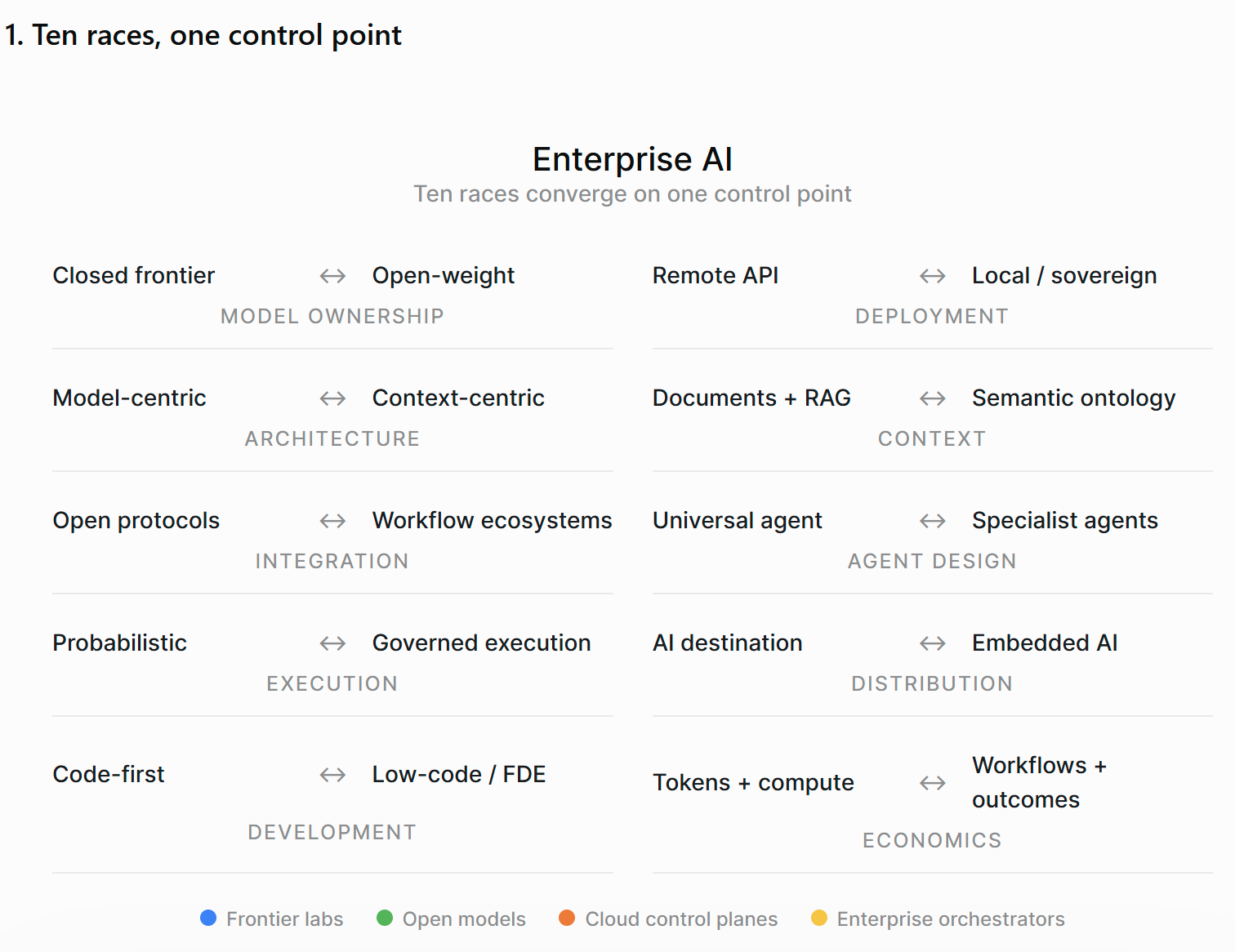
Ten competitions do not carry equal weight. Five are consequences: model ownership, deployment, agent design, distribution and development all follow from decisions taken elsewhere. Five are causes — architecture, context, integration, execution and economics — and they are the subject of the rest of this paper.